top of page
  • Writer: Annie Mason
    Annie Mason
  • 2 min read

ree

A New Year, a new look. Whether it's a whole new makeover or adding a vase to a tabletop, I love giving a room that extra touch, Some "pizzazz" (an attractive combination of vitality and glamour).


We have recently moved and it is so much fun to take an object and find a new spot for it. The links below will help you do just that.


* As an Amazon Associate, I earn a small commission from the links below, at no extra cost to the buyer. I have listed products that are stylish and would perk up any room. Thank you for your purchase as the commissions help with website maintenance.


For the living area:

ree


For the Bath


ree


For the Bedroom

ree


For the Nursery


ree


For the Rec Room


ree


For the Garage / Exercise Room


ree


Thank you for visiting!


Pin it, please! ⬇ or comment below.


ree

ree


  • Writer: Annie Mason
    Annie Mason
  • 6 min read

ree
George Walter Vincent Smith Museum of Art, Springfield, MA

This is a list of the museums where I have worked. All have different perspectives, art types, and periods of art. All of these experiences are vividly part of my study in art history; they have me reflecting on the past and how far back these experiences have linked me to my love of art.


1. George Walter Vincent Smith Museum of Art


This was the museum where I interned as a student in the Department of Art History at the University of Massachusetts (UMASS-Amherst). This art museum holds the eclectic collections of George Walter Vincent Smith (1832-1923) and his wife, Belle Townsley Smith (1845-1928), in an Italian palazzo-style building established in 1896. It's a museum that could speak to us if it could...and maybe it does Haunted Springfield.


One of my fellow graduate colleagues, Janet Gelman, was the Education Curator. We immediately bonded as we shared our affinity for children's art education: she was in the museum setting, and I had an elementary art teacher background. We had long talks over coffee or sandwiches. Inevitably, the children's theme slipped into what Professors had thrown at us. Graduate school is a world unto itself. Long papers, research, sleepless nights, critiques that didn't go so well. Both of us were old enough to take things in stride and move on. The younger students admired our "c'est la vie" attitude regarding our studies.


It is part of "The Quadrangle" in Springfield, Massachusetts.


Among the varied themes of the George Walter Vincent Smith Museum are:

  • Vast holdings include one of the largest collections of Chinese cloisonné outside of Asia.

  • Japanese Arms and Armor

  • Tiffany Stained Glass windows

  • 19th-century Middle Eastern carpets

  • Hasbro Games Art Discovery Center for children's classes

  • American Paintings Salon


ree
Mr Mrs. George Walter Vincent Smith by Thomas Waterman Wood

What a blessing to have had this experience at a museum near where I was born. This building is a museum's museum: the eighteenth-century ambiance, the long halls and grand paintings upon paintings, and the eyes of antiquity all around = my definition of heaven.


2. The Porter-Phelps-Huntington House Museum


ree

I worked at this museum while I was a graduate student at UMASS-Amherst. My role was curator and docent, and I loved this job. I lived just down the road in Hadley, Massachusetts, and the director, Susan Lisk, became a close friend when I worked there.


What a history this house has. For a detailed background, consider Forty-Acres: The Story of the Bishop Huntington House


This unique museum has a magnificent history. As a docent, I often toured a small party through the house, and the "one-hour tour" became two.

This well-preserved 18th-century house was continuously occupied by a single family in 1752 until the death of Dr. James Lincoln Huntington, the museum's founder. The house contains many interesting items belonging to the family and preserved for over 300 years. The Porter-Phelps-Huntington papers are now preserved at Amherst College Archives and Special Collections.


My memories of this museum are distinct since so many families occupied the house. There are also references to supernatural events dating back to the Huntington years. You can check some of the tales here: "Ghost" Stories.


I had my encounter. I was doing some curator tasks in the Director's home. Back in the day of electric typewriters, when errors needed to be changed in the text, I found myself putting back a pencil that rolled off the desk. And then, again. And then, again. I started to freak out because I sensed that "someone" was in the room. It was eerie.


Suffice it to say this is a beautiful museum, and if you are ever in the Hadley, MA, area, it's worth planning a tour. TripAdvisor


3. Yale Center for British Art


ree
the modern Yale Center for British Art across from Yale Art Gallery

How could I have been so lucky to land a position at this beautiful museum? Well, luck and a heads-up from a fellow student in the Art History department. She graduated a semester before I did and had been in the Photograph Cataloguer role at the BAC (British Art Center) but was leaving for another museum. I applied for this position and interviewed with the head of the Yale Photograph Archive department, author Anne-Marie Logan. Soon I was headed to New Haven, CT to work at this prestigious museum.


The internationally acclaimed American architect Louis I. Kahn (1901–1974) designed it to house Paul Mellon's (Yale College, Class of 1929; 1907–1999) extraordinary gift to Yale University. It was the first museum in the United States to incorporate retail shops in its design.


ree
The hall area between the Photograph Archives and the Prints Collection

The geometrical four-floor interior is designed around two interior courtyards and comprises a restrained palette of natural materials, including travertine marble, white oak, concrete, and Belgian linen. Kahn succeeded in creating intimate galleries where one can view objects in diffused natural light. He wanted to allow in as much daylight as possible, with artificial illumination used only on dark days or in the evening. The building’s design, materials, and skylit rooms combine to provide an environment for the works of art that is simple and dignified.


4. The Pardee-Morris House

Again, one thing leads to another in my life. After I got the job at Yale, I needed a place to live. It turns out that Susan Lisk of the Porter-Phelps-Huntington House (see above) had a sister, Linda, who lived in New Haven, Connecticut, and she spent a whole day with me checking the rentals in the city. I found a lovely place with daily public transportation to downtown. Linda also suggested that I might want to docent at this house museum for a little extra income. Who would have thought it? Two sisters who have been part of my museum adventures.


One of New Haven’s oldest structures, this historic property descended in one family through seven generations.


ree

This beautiful house, dating to 1680, is a rare example of a stone ender. The ell was added around 1767. On July 5, 1779, during the Revolutionary War, the British raided New Haven and burned the house. Using the surviving stone and timbers, Captain Amos Morris rebuilt the home the following year.


In 1915, William Pardee bought and restored the house,


ree

In 1918, William S. Pardee, a descendant of the Morris family, bequeathed the property to the New Haven Colony Historical Society, which is today known as the New Haven Museum.


The oldest portions of the house are believed to date to the late 17th century, probably during the lifetime of Thomas Morris, the first colonial grantee of land in this area, or one of his sons. It was partially burned by the British in 1779. It remained with the Morris family until 1915, when it was sold to William Pardee. He briefly occupied the house and willed it to the historical society upon his death a few years later, along with an endowment for its care.


My time here was primarily on weekends. I was the only docent and had to open and close the property during the tourist season. This, too, was a property with a lot of history and a fun building to present to curious visitors. During this period (the late 1980s), the future of this museum was risky and uncertain.


ree

How happy I am to see that the New Haven Museum bought the structure and now has summer concerts on the lawn. This has brought new life to the museum and joy to the visitors.


5. Kenmore Foundation


I traveled to Virginia to see my sister during my years at Yale. She quietly planned a gathering at her home and invited a few friends, including an invitation to the bachelor who had built a house across the street. Soon after, this man asked me to marry him, and I said, "Yes."


I moved to Virginia in 1989 and have lived there since then. Not wanting to give up on my love of museums, I learned about Kenmore Plantation in Fredericksburg, Virginia.


ree

My role began at Kenmore as a docent. I loved it! I have an affinity for welcoming visitors and telling the stories of the objects and people who lived there. The other volunteers, most older than I, were helpful and guided my early start. Not many months later, I began to work with the Education Director, Stacia Gregory Norman, and I helped catalog the photographs and papers. In my second year, W. Vernon Edenfield took notice and offered me the position of Education Assistant.


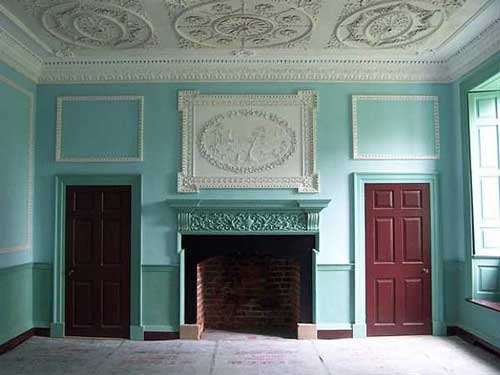
Kenmore is the Fredericksburg home of Revolutionary War patriot Col. Fielding Lewis and his wife, Elizabeth "Betty" Washington, George Washington's only sister. In Kenmore's spacious interior, the plaster designs on the 12-foot-high ceilings combine baroque, neoclassical, and rococo elements. Use arrows to slide:


My days at these museums are long gone, but they are not forgotten. I gained knowledge, insight, and history and have met amazing people. I am grateful for the opportunities that these experiences provided.


For those with the notion that museums are places for the "haunting," here are some books:


Pin it, please, or comment below this post.


ree

ree


  • Writer: Annie Mason
    Annie Mason
  • 4 min read

This series will introduce artists associated with certain states. This is Maine.


ree


Robert Feke

c. 1705 - c. 1752


ree
Brigadier General Samuel Waldo"by Robert Feke c .1748

An artist not born in Maine, but painted many landowners in Maine including the wealthy Waldo family, who made fifteen trips abroad to bring settlers to the Penobscot region.


Like others among his peers, Feke lived in Boston, but as with other painters, he was sought out by the wealthy landowners in New England, who would have their portraits done to show their wealth and prosperity for all to see.


Born in Oyster Bay, Long Island, these artists honed their skills with the ability

to render gold embellishments and silk or fur textures of clothing that gave the viewer a sense of noble stature that was relished and expected.


ree
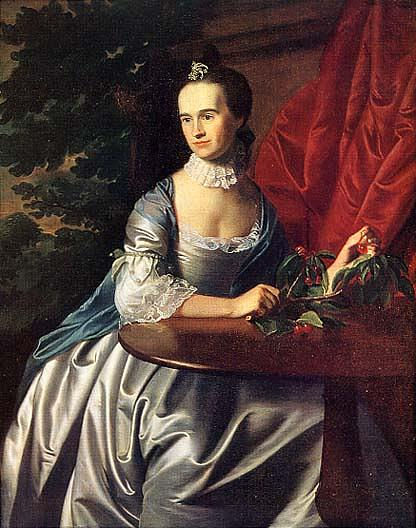
"Mrs. Samuel Waldo" oil. by John Singleton Copley


John Singleton Copley


Active in both colonial America and England, Copley became well-established as a portrait painter of the wealthy in colonial New England; Copley was the greatest and most influential painter in colonial America, producing about 350 works of art.


Mrs. Waldo lived in Maine but would have had to travel to Boston to see her father, the wealthy shipowner and merchant John Erving, and her older sister, Mrs. James Bowdoin II (wife of the 2nd Governor of Massachusetts). Copley was at the height of his career in New England and built a reputation in Maine and Boston, Massachusetts.


The next artist is more well-known and a painting that my readers will probably be familiar with.


Andrew Wyeth

1917 - 2009


ree
Christina's World 1948

In the stark landscape of coastal Maine, Christina’s World depicts a young woman seen from behind, wearing a pink dress and lying in a grassy field. Although she appears to be in a position of repose, her torso, propped on her arms, is strangely alert; her silhouette is tense, almost frozen, giving the impression that she is fixed on the ground. She stares at a distant farmhouse and a group of outbuildings, ancient and grayed in harmony with the dry grass and overcast sky.


Wyeth’s neighbor Anna Christina Olson inspired the composition, one of four paint­ings by Wyeth in which she appears. As a young girl, Olson developed a degenerative muscle condition—possibly polio—that left her unable to walk. She refused to use a wheelchair, preferring to crawl, as depicted here, using her arms to drag her lower body along. “The challenge to me,” Wyeth explained, “was to do justice to her extraordinary conquest of a life which most people would consider hopeless.”


As an art student, Wyeth was both praised and lambasted and this painting followed that criteria, as in this article For Wyeth, Both Praise and Doubt. My professors coughed when they had to refer to him, mocked him as an "illustrator" like Norman Rockwell, and pilloried Christina's World as a 'dorm room poster.' Wyeth had homes both in Chadds Forth, PA, and Maine. I was very familiar with his Maine subjects as I spent my summers with relatives who lived in the state.

ree
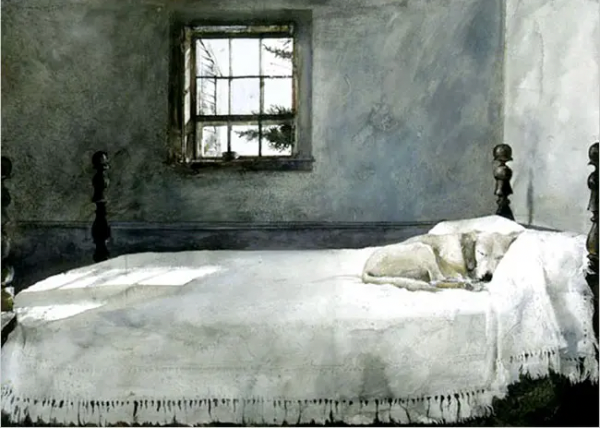
Master Bedroom. watercolor 1965

Andrew Wyeth was the son of noted illustrator N. C. Wyeth. Andrew was called both a radical and old-fashioned.

He worked in an era that brought forth abstractionists like Jackson Pollock. Wyeth's work shown here certainly has a minimalist look, and it evokes a stark and lonely setting that is now recognized as an underlining theme of the younger Wyeth's work.


Winslow Homer

1836 - 1910


ree
Winslow Homer - The Fog Warning 1885 MFA Boston

It sure looks like Maine. Homer was influenced by an 1884 trip to the Grand Banks fishing grounds, "The Fog Warning" is one of a series in which the artist depicted the difficult lives of New England sailors and their families.


ree

At fifty, Homer had become a "Yankee Robinson Crusoe, cloistered on his art island" and "a hermit with a brush." These paintings established Homer, as the New York Evening Post wrote, "in a place by himself as the most original and one of the strongest of American painters.


Again, I summered in Maine during much of my young adulthood. These artists and others were part of my desire to learn about Maine artists, visit art museums in the area, and go on to study as an art student in Massachusetts and at Haystack Mountain School of Crafts. I was an apprentice in weaving crafts and jewelry making for several summers. Since these early days, the school has established partnerships with the likes of MIT whose programs seek to combine artists and scientists to take over the campus and explore the integration of emerging technologies and processes for the crafts.


Living Maine Artists


Rachael O'Shaughnessy


ree
"Scarborough Drift" oil on canvas 6" x 4"

Perhaps best known for witnessing thousands of consecutive sunrises over the ocean and the resulting atmospheric drawings and paintings, Rachael O’Shaughnessy is passionate about ocean storms as they meet art. Rachael's recent luminist works echo the sublime works by J.M. W. Turner in her passion for color and light as they meet the Maine and New England coastline.


C. R. Bryant


ree
"Maelstrom" by C.R. Bryant oil on panel. 12" x 16"

For over 65 years, C.R. (Bob) Bryant has followed a lifelong journey to perfect his portrait painter and maritime artist ability. Known for his ability to paint water, Bryant also has a working knowledge of sailing ships, and today, he is recognized as a leading international marine artist.


He is a core artist at the Maritime Gallery at Mystic Seaport and a co-founder and senior fellow at the Pacific Rim Institute of Marine Artists.


Lastly, I give the nod to one of my professors in the Art Department at my alma mater, Westfield State Unversity:


Frederick Lynch

1935 - 2016


Having lost touch with Fred Lynch I was sad to see that he had passed in 2016. In my "freshman" year, it was Art History I, which he taught. I couldn't get enough of reading and analyzing the art from Caveman to Pollock. Professor Lynch played a role in my decision to go into teaching. He strongly impacted my future in later years when I chose to continue my education. I enrolled in the Art History program at the University of Massachusetts at Amherst, completing my Master's in that major.


He was one of the few professors who balanced his teaching responsibilities with being a "working" artist. He frequently had exhibitions on campus and encouraged his students to do the same. The art department was active on campus, and I am proud to have the foundation for my teaching career and my background in museum study and curatorship.


Here are a few samples of the works by Fred Lynch:


ree
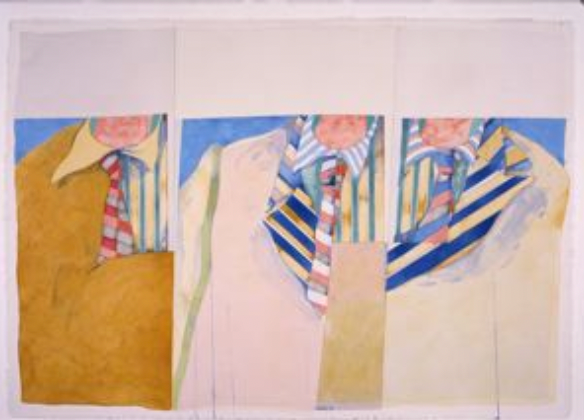
"Almost Three Persons" by Fred Lynch
ree
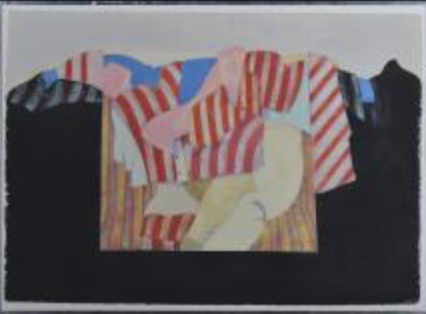
"Cache" by FWred Lynch. Mixed Media


Books:


Pin it, Please. Comments below.


ree

ree


bottom of page